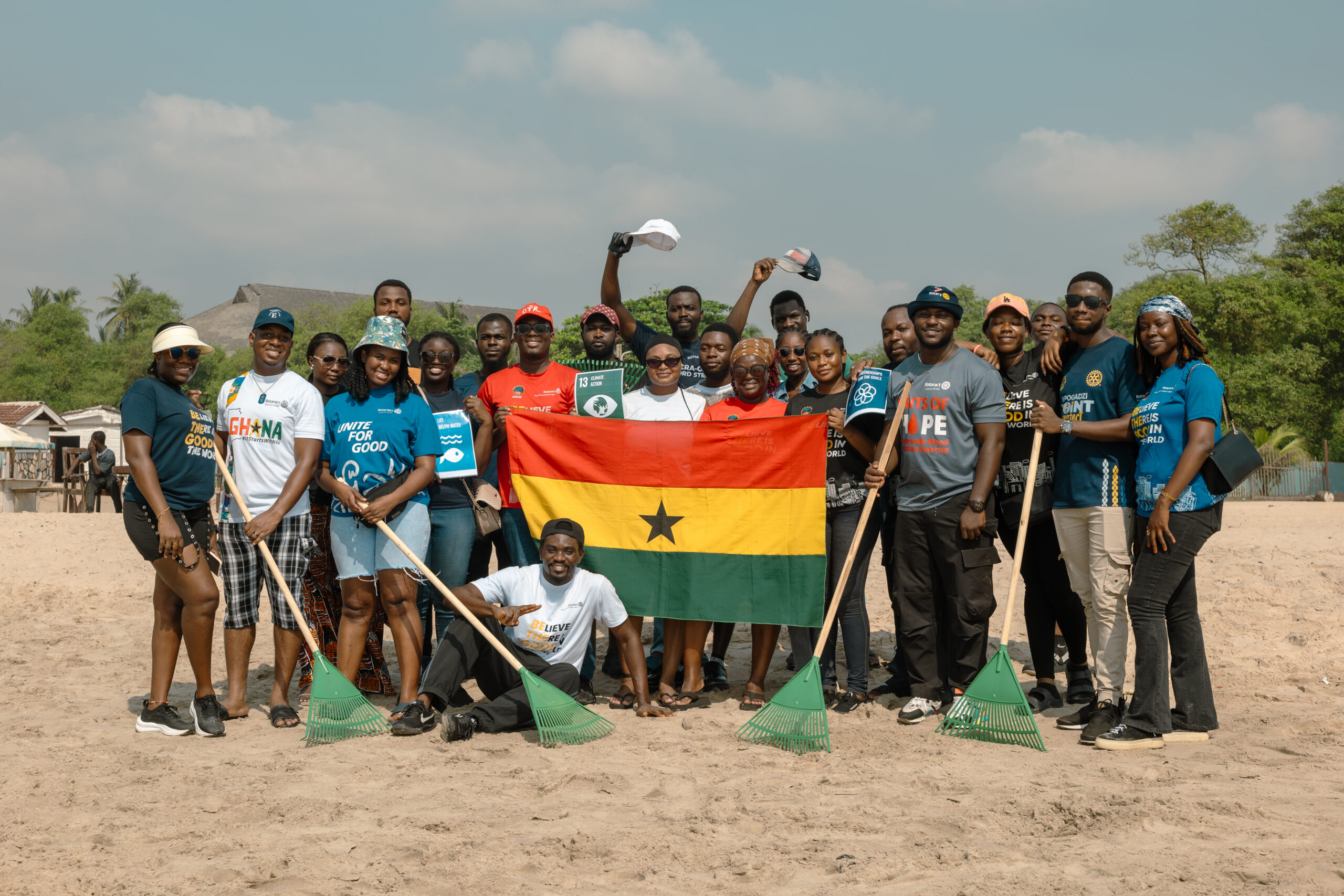
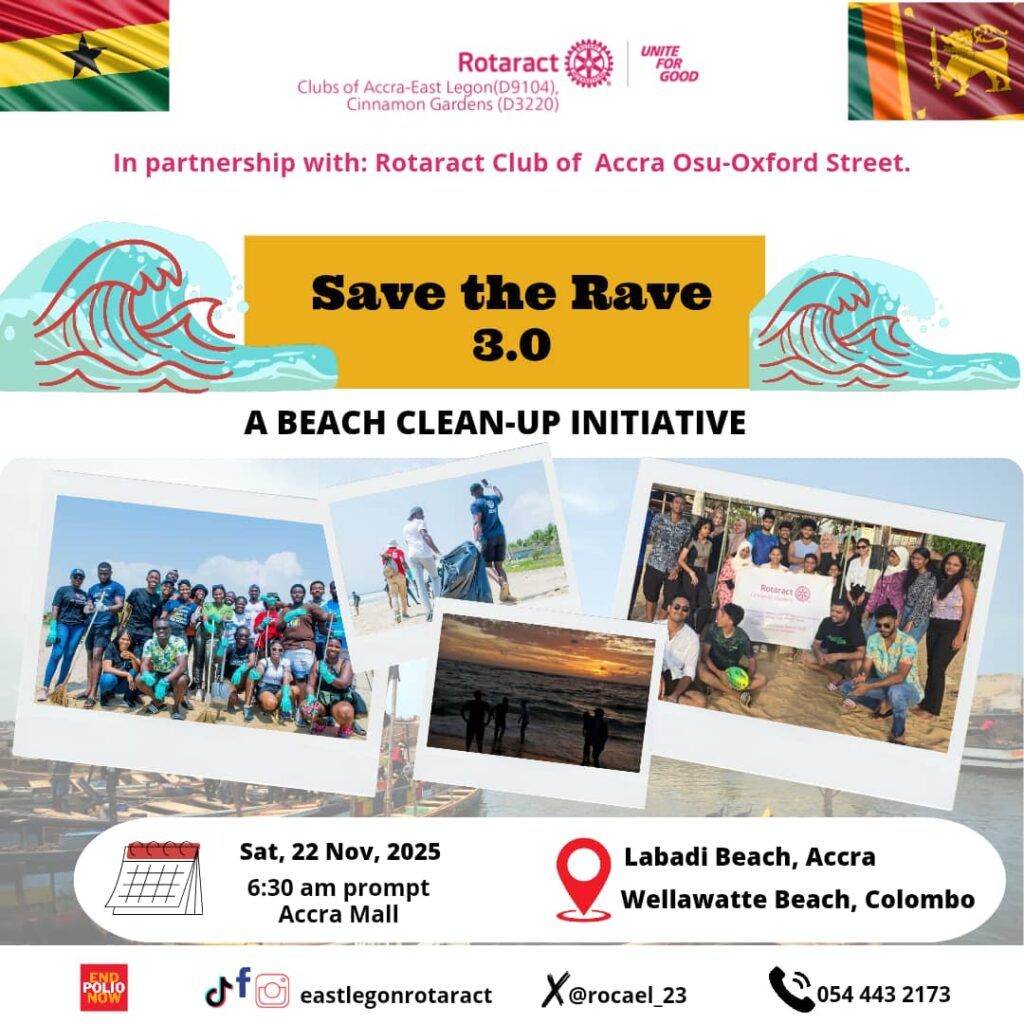
 Coastal pollution remains one of the most visible environmental challenges facing communities worldwide. In a remarkable demonstration of international collaboration, the Rotaract Club of Accra–East Legon (Ghana D9104) and the Rotaract Club of Cinnamon Gardens (Sri Lanka), District 3220, organized a co-current beach clean-up on Saturday, 22nd November 2025. The initiative, held simultaneously in both countries, aimed to restore polluted shorelines while raising awareness about responsible waste management and the protection of marine ecosystems.
Volunteers in Ghana worked along Labadi Beach, while counterparts in Colombo tackled Wallawatte Beach, both hotspots for plastic waste, fishing debris, and refuse washed in from nearby communities. Members of the Accra–East Legon club collaborated with sanitation workers and community stakeholders to clear the shoreline, creating a safer and more welcoming environment for the public. According to Shafeeq Nii Odoi Nsiah, President of Accra-East Legon, the project aligns directly with Rotary’s Areas of Focus, particularly Environmental Protection and Water, Sanitation, and Hygiene. “This beach clean-up is about making the environment safer, not just for people, but for marine ecosystems as well.”
Beyond the physical clean-up, the project served as a platform for education and advocacy. Volunteers engaged beachgoers on the importance of proper waste disposal, the long-term consequences of pollution on marine life, public health, and tourism. The exercise underscored that beach pollution often originates inland, highlighting the need for collective action and sustained community engagement to prevent waste from reaching the ocean.
Simultaneously, members of the Rotaract Club of Cinnamon Gardens carried out a similar clean-up along their coastline, tackling the same challenges of marine litter and environmental degradation. The co-current initiative not only amplified the impact on local communities but also strengthened international fellowship, reinforcing Rotary’s global commitment to environmental sustainability and cross-border collaboration.
While clean-ups make an immediate difference, both clubs emphasized that lasting change requires more than periodic interventions. Stronger waste management systems, preventive measures, and community education are essential to reduce the volume of waste entering oceans. The joint beach clean-up stands as a powerful example of how young leaders can unite across continents to protect natural resources, advocate for sustainability, and inspire communities toward a cleaner, healthier planet.
Link to Youtube: https://www.youtube.com/watch?v=iV3U1Kto0dk&pp=ygU7YWlyIHBvbGx1dGlvbiBlbWlzc2lvbnMgZWx0b24gYnJvYmJleSBhbWVnYWggc2FkcmEga3dhcnRlbmfSBwkJKQoBhyohjO8%3D

%20and%20the%20Rotaract%20Club%20of%20Cinnamon%20Gardens%20(Sri%20Lanka),%20District%203220,%20organized%20a%20co-current%20beach%20clean-up%20on%20Saturday,%2022nd%20November%202025.%20The%20initiative,%20held%20simultaneously%20in%20both%20countries,%20aimed%20to%20restore%20polluted%20shorelines%20while%20raising%20awareness%20about%20responsible%20waste%20management%20and%20the%20protection%20of%20marine%20ecosystems./spanspan%20style=font-weight:%20400;Volunteers%20in%20Ghana%20worked%20along%20Labadi%20Beach,%20while%20counterparts%20in%20Colombo%20tackled%20Wallawatte%20Beach,%20both%20hotspots%20for%20plastic%20waste,%20fishing%20debris,%20and%20refuse%20washed%20in%20from%20nearby%20communities.%20Members%20of%20the%20Accra–East%20Legon%20club%20collaborated%20with%20sanitation%20workers%20and%20community%20stakeholders%20to%20clear%20the%20shoreline,%20creating%20a%20safer%20and%20more%20welcoming%20environment%20for%20the%20public.%20According%20to%20/spanbShafeeq%20Nii%20Odoi%20Nsiah/bspan%20style=font-weight:%20400;,%20President%20of%20Accra-East%20Legon,%20the%20project%20aligns%20directly%20with%20Rotary’s%20Areas%20of%20Focus,%20particularly%20/spanbEnvironmental%20Protection/bspan%20style=font-weight:%20400;%20and%20/spanbWater,%20Sanitation,%20and%20Hygiene/bspan%20style=font-weight:%20400;.%20“This%20beach%20clean-up%20is%20about%20making%20the%20environment%20safer,%20not%20just%20for%20people,%20but%20for%20marine%20ecosystems%20as%20well.” /spanspan%20style=font-weight:%20400;Beyond%20the%20physical%20clean-up,%20the%20project%20served%20as%20a%20platform%20for%20education%20and%20advocacy.%20Volunteers%20engaged%20beachgoers%20on%20the%20importance%20of%20proper%20waste%20disposal,%20the%20long-term%20consequences%20of%20pollution%20on%20marine%20life,%20public%20health,%20and%20tourism.%20The%20exercise%20underscored%20that%20beach%20pollution%20often%20originates%20inland,%20highlighting%20the%20need%20for%20collective%20action%20and%20sustained%20community%20engagement%20to%20prevent%20waste%20from%20reaching%20the%20ocean./spanspan%20style=font-weight:%20400;Simultaneously,%20members%20of%20the%20Rotaract%20Club%20of%20Cinnamon%20Gardens%20carried%20out%20a%20similar%20clean-up%20along%20their%20coastline,%20tackling%20the%20same%20challenges%20of%20marine%20litter%20and%20environmental%20degradation.%20The%20co-current%20initiative%20not%20only%20amplified%20the%20impact%20on%20local%20communities%20but%20also%20strengthened%20international%20fellowship,%20reinforcing%20Rotary’s%20global%20commitment%20to%20environmental%20sustainability%20and%20cross-border%20collaboration./spanspan%20style=font-weight:%20400;img%20class=alignnone%20wp-image-4088%20size-thumbnail%20src=https://rocael.com/wp-content/uploads/2026/02/WhatsApp-Image-2026-02-09-at-8.29.49-PM-150x150.jpeg%20alt=%20width=150%20height=150%20img%20class=alignnone%20wp-image-4087%20size-thumbnail%20src=https://rocael.com/wp-content/uploads/2026/02/WhatsApp-Image-2026-02-09-at-8.29.49-PM-2-150x150.jpeg%20alt=%20width=150%20height=150%20img%20class=alignnone%20wp-image-4086%20size-thumbnail%20src=https://rocael.com/wp-content/uploads/2026/02/WhatsApp-Image-2026-02-09-at-8.29.49-PM-1-150x150.jpeg%20alt=%20width=150%20height=150/spanspan%20style=font-weight:%20400;While%20clean-ups%20make%20an%20immediate%20difference,%20both%20clubs%20emphasized%20that%20lasting%20change%20requires%20more%20than%20periodic%20interventions.%20Stronger%20waste%20management%20systems,%20preventive%20measures,%20and%20community%20education%20are%20essential%20to%20reduce%20the%20volume%20of%20waste%20entering%20oceans.%20The%20joint%20beach%20clean-up%20stands%20as%20a%20powerful%20example%20of%20how%20young%20leaders%20can%20unite%20across%20continents%20to%20protect%20natural%20resources,%20advocate%20for%20sustainability,%20and%20inspire%20communities%20toward%20a%20cleaner,%20healthier%20planet./spanspan%20style=font-weight:%20400;Link%20to%20Youtube:%20/spana%20href=https://www.youtube.com/watch?v=iV3U1Kto0dk&pp=ygU7YWlyIHBvbGx1dGlvbiBlbWlzc2lvbnMgZWx0b24gYnJvYmJleSBhbWVnYWggc2FkcmEga3dhcnRlbmfSBwkJKQoBhyohjO8%3Dspan%20style=font-weight:%20400;https://www.youtube.com/watch?v=iV3U1Kto0dk&pp=ygU7YWlyIHBvbGx1dGlvbiBlbWlzc2lvbnMgZWx0b24gYnJvYmJleSBhbWVnYWggc2FkcmEga3dhcnRlbmfSBwkJKQoBhyohjO8%3D/span/aspan%20style=font-weight:%20400;img%20class=aligncenter%20wp-image-4093%20%20src=https://rocael.com/wp-content/uploads/2026/02/WhatsApp-Image-2026-02-09-at-8.29.56-PM-1024x1024.jpeg%20alt=%20width=616%20height=616%20 img%20class=alignnone%20wp-image-4091%20size-thumbnail%20src=https://rocael.com/wp-content/uploads/2026/02/WhatsApp-Image-2026-02-09-at-8.29.51-PM-1-150x150.jpeg%20alt=%20width=150%20height=150%20img%20class=alignnone%20wp-image-4090%20size-thumbnail%20src=https://rocael.com/wp-content/uploads/2026/02/WhatsApp-Image-2026-02-09-at-8.29.50-PM-150x150.jpeg%20alt=%20width=150%20height=150%20img%20class=alignnone%20wp-image-4089%20size-thumbnail%20src=https://rocael.com/wp-content/uploads/2026/02/WhatsApp-Image-2026-02-09-at-8.29.50-PM-1-150x150.jpeg%20alt=%20width=150%20height=150 /spanimg%20class=alignnone%20wp-image-4092%20size-thumbnail%20src=https://rocael.com/wp-content/uploads/2026/02/WhatsApp-Image-2026-02-09-at-8.29.51-PM-150x150.jpeg%20alt=%20width=150%20height=150)